Summary
On 9th July 2021, a whitehat discovered a vulnerability in the THORChain router when dealing with ERC-777 tokens and worked with the team to rescue the funds back to the THORStarter deployer account. The Router was patched and deployed to testnet, but during testing an issue when dealing with non-standard ERC-20’s was found, specifically USDT. A recovery plan was posed to the community, which was to rescue the USDT back to the treasury (after a 24 hour notice) and the rest of the tokens migrated via the normal Router Upgrade path. Complications arose since simultaneously the Testnet was found to not be operational, so a new one had to be established. Ultimately the router was upgraded and trading resumed.
Details
ERC-777 Re-entrancy
A simple bug, but not one contemplated at the time the Router was deployed or reviewed by the THORChain community for MCCN launch. An audit of the Router was scheduled to be performed by TrailOfBits in July, which will go ahead but now on Router V3.
The root cause is that ERC-777 allows hooks to be called on transfers. This is the same as sending ETH to a contract (a hook can be called). The hook called a secondary deposit into the router, which caused the funds to be partially “double-dipped” and the member credited more allowance than they should. The member called recursive deposits until their “allowance” was the full Router balance. They then transferred this out.
The fix was to add a simple re-entrancy guard.
https://gitlab.com/thorchain/ethereum/eth-router/-/blob/master/contracts/THORChain_Router.sol
Trading Halt
A trading halt via mimir was then established since un-aware users could deposit XRUNE (to sell) and have them immediately stolen by copycats.
An obvious improvement to this is to have a chain-specific halts instead of global halts. This was obvious, since the entire network was not operational when it was just one chain that was problemetic.
This has now been prepared and due for release:
Resolve “ADD: chain-specific halt trading”
Testnet Issues
The THORChain core devs do not run any bonded mainnet or testnet nodes. They only run full-nodes which make services available to the community (such as thornode.thorchain.info).
Multichain Testnet operators use it to practice churning. There is a known issue that Nodes are slightly ETH insolvent (due to gas issues) and cannot unbond. This is known to cause friction for Node Operators (perhaps they need better tooling) causing some of them to give up and abandon their nodes instead of fixing the issue and leaving gracefully. Due to unfortunate timing, more than 1/3rd of the network was offline/abandoned and could not be used for testing.
This is unlikely to happen on mainnet — no sane operator would abandon a $3m+ bond.
Re-establishing a new testnet cost the team a day.
Router Issues
Whilst testing the Router, another issue came to fruition — the USDT asset could not be migrated since it was not compatible with the ERC-20 standard.

The fix was to remove the ERC-20 interface, encode it directly in the function and simply require success — this skips looking for any returned data.

USDT Recovery
Since USDT was not compatible with the preferred migration path, there were three options posed to the community:
Ragnarok all USDT LPs and migrate with no USDT
Recover the USDT to a treasury address, migrate manually
Recover the USDT to a smart contract, migrate trustlessly (anyone could call the subsequent deposit)
The community ultimately settled on (2) as the safest and fastest way to pull off the recovery since the intent was to re-establish swaps, and not a test of decentralisation.
Migration Coordinator
Normally Router upgrades are designed to be trustless and autonomous. As soon as a new Router is added to the network, the nodes will churn towards it using existing churn logic. They pass the router into their call data, and the smart contract *itself* will migrate forward; see the code below.
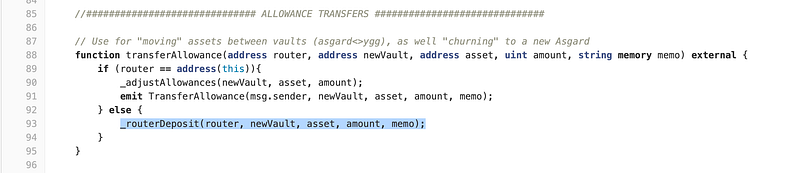
However, this upgrade was urgent, and required additional steps, such as rescuing USDT and re-depositing USDT and XRUNE back in. As such, special logic was added to allow mimir to orchestrate the process. The exact 11 steps as below:1. Mimir set `StopFundYggdrasil` to `1` , this will stop funding yggdrasil vaults
2. Mimir set `MimirRecallFund` to `1` , this thet network will ask yggdrasil to send all their fund back to asgard on ETH chain
3. Double check all yggdrasil vaults return their erc20 tokens , if all yggdrasil vault only has dust ETH left in it , then go to step 4)
4. Mimir set `MimirWithdrawUSDT` to `1` to extract USDT , this will trigger the USDT outbound, make sure the outbound has been send all USDT to designate address
5. Mimir set `MimirUpgradeContract` to `1` , this will trigger the network to upgrade contract to new one
6. Make sure all yggdrasil contract has been updated to the new contract address
7. Mimir set `ChurnInterval` back to 43200 so node churn can be kicked off
8. Once churn kicked off , make sure the new asgard has the new contract, and migrate is migrating fund to new contract
9. When churn finished , credit USDT and XRUNE back to new asgard, new contract using memo `noop`
10. Mimir set `StopFundYggdrasil` to 0 , the network will go ahead to fund yggdrasil vaults
11. Once ygg funded, Mimir set `HaltTrading` to 0 , the network will be available for swaps
Return to Operations
The team and community worked together to orchestrate this:
1) Sync the upgrade to tip
2) Release the upgrade and wait for 100% of nodes to adopt
3) Coordinate the Router Migration
4) Re-establish trading
This was finally finished on 14 July — 5 days after the halt.
Improvements
The list of improvements:
RouterV2 has a re-entrancy guard, compatible with ERC-20s that are non-standard, and has a new function requested by the community to expire deposits
THORChain community has validated the Router Upgrade logic and will be prepared to more readily migrate to Router V3 (with more advanced logic).
THORNode will have a chain-specific trading halt logic, which would have kept the network mostly operational
Re-establish Testnet and engage with high-quality node operators to run the testnet.
In addition, the RouterV3 will be audited by both Halborn and TrailOfBits soon.
Community
To keep up to date, please monitor community channels, particularly Telegram and Twitter:
- Twitter: https://twitter.com/thorchain_org
- Telegram Community: https://t.me/thorchain_org
- Telegram Announcements: https://t.me/thorchain
- Reddit: https://reddit.com/r/thorchain
- Gitlab (primary): https://gitlab.com/thorchain
- Github (secondary): https://github.com/thorchain
- Medium: https://medium.com/thorchain

Related articles
![]()
May. 14, 2026
Explanation of the 6 Preset Strategies to Help Create Your CCL Strategy
![]()
May. 13, 2026
The Casino Problem: When Crypto Forgets What It Was Built For
![]()
May. 12, 2026
THORChain Protocol Upgrade v3.18
![]()
May. 11, 2026
Dash is coming to THORChain
![]()
May. 8, 2026
Monero Merged, Reserve Burn, Marketing Update | Podcast #196
![]()
May. 7, 2026
Marketing Update: Feb - March 2026
![]()
May. 5, 2026
RUJI Staking Rewards Are Live, Earn Real Protocol Revenue on Rujira
![]()
May. 4, 2026
Bior Labs Cards Are Imminent: Bill Pay, $10K Virtual Cards and a Stablecoin Alpha
![]()
May. 2, 2026
Live from Bitcoin Vegas: 2 bps Stable Swaps, v3.18 Next Week and the Affiliate Revshare Plan
![]()
Apr. 30, 2026
THORChain Quarterly report - Q1 2026
![]()
Apr. 29, 2026
bRUNE Staking Cap Increased to 2 Million, How to Stake, and Earn THORChain Yield
![]()
Apr. 28, 2026
Protocol Upgrade - v3.17.0
![]()
Apr. 27, 2026
Unstoppable: The Best Privacy Wallet – THORChain Mobile Interface
![]()
Apr. 24, 2026
THORChain Stands for a Permissionless and Decentralized Ethos
![]()
Apr. 23, 2026
Custom Concentrated Liquidity: Where Liquidity Becomes Strategy